Improved Communication Structures for Power Systems
Project Overview
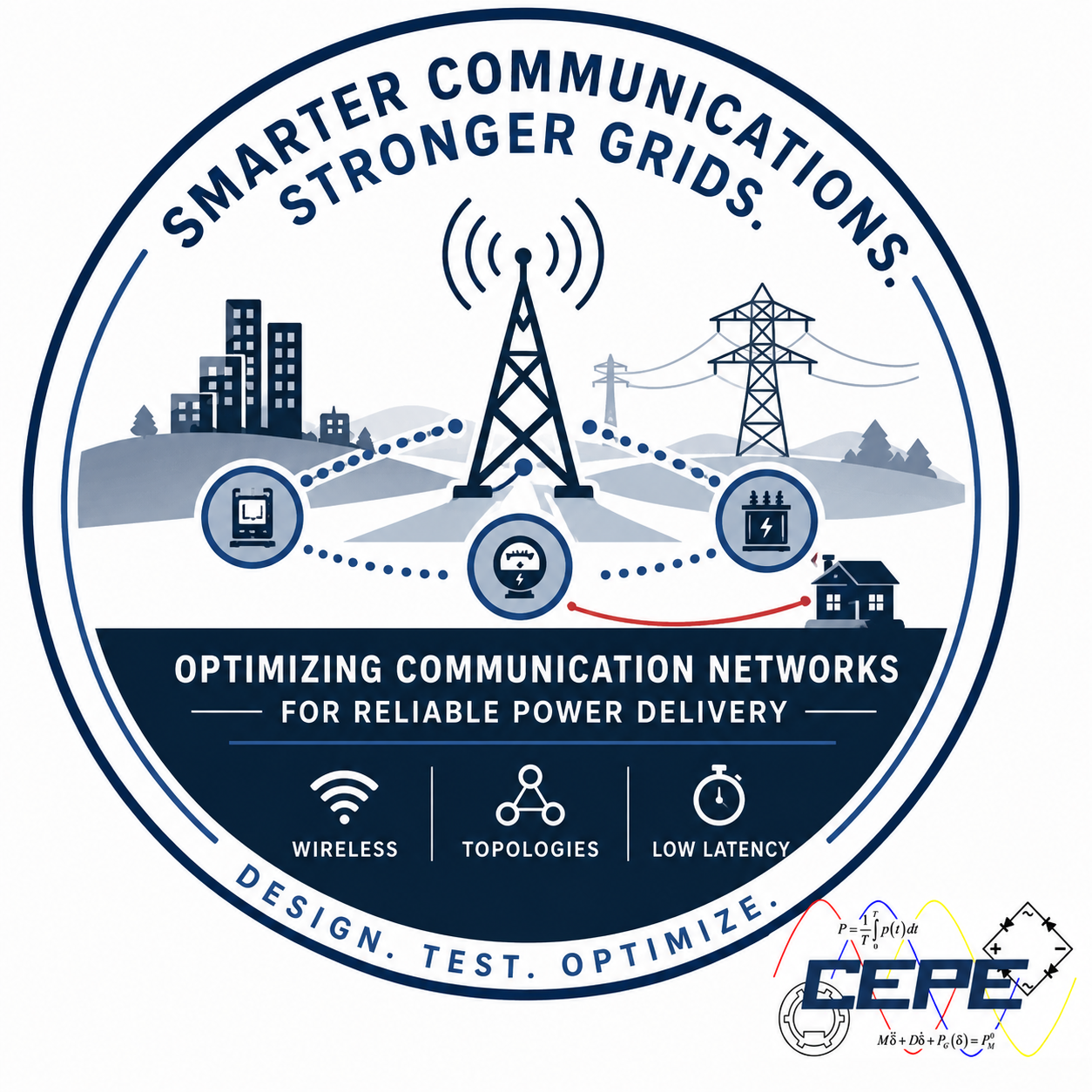
One Liner: Designed and evaluated wired and wireless communication network topologies for power distribution systems to minimize end-to-end latency and improve real-time electric grid reliability under dynamic load conditions.
Communication systems in power distribution play a critical role in how adjustments at the
utility level affect the reliability of the power being delivered. At the power grid scale, loads are
constantly changing with peaks appearing mid-day and troughs during the night, leading to a
dynamic status of the loads. A changing load status incurs errors between the expected and
actual voltage measurements causing an unreliable grid. Communication systems have now
become vital in delivering the data of the load status to utility facilities so that these errors can be
minimized. However, the current communication systems in use today are dated, if used at all,
and lead to large delays in receiving measurements and applying electric grid corrections. Large
scale errors then arise when this phenomenon is scaled across an electric grid. By testing
different network topologies, an optimal solution can be obtained for a system with minimal
delay. This project will test different load cases simulating different environments (urban,
suburban, and rural) across three network topologies (star, ring, and hybrid) to find the
combinations that lead to minimal end to end delay between receiving measurement data and
applying electric grid corrections. It will also study the tradeoffs of different types of links
through studies in a wired vs wireless network. Combining all the test results will yield a
solution to the communication systems problem in different environments and can be scaled to
enhance power delivery at the electric grid level.
Video available at this link.
Screenshots
3 image(s)