Ingestible Electronics: The Smart Pill Device
Project Overview
One Liner: Exploring the intersection of biomedical devices, controls, and intelligent sensing through the development of a smart ingestible capsule capable of real-time physiological monitoring.
Gastrointestinal disorders affect millions of individuals worldwide, yet many existing diagnostic techniques remain invasive, expensive, and uncomfortable for patients. This project presents the development of a proof-of-concept capsule-based sensing device designed for laboratory simulation of gastrointestinal diagnostic functions. The objective was to create a low-cost platform capable of combining visual imaging and pH sensing within a single capsule housing while demonstrating the feasibility of integrating multiple sensing modalities into a compact system.
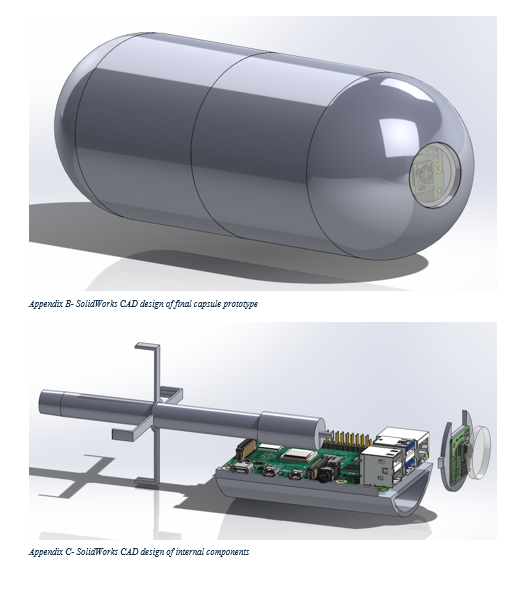
The prototype consists of a custom-designed PETG capsule housing containing a Raspberry Pi 4, Raspberry Pi camera module, analog pH sensor, and supporting internal structures. The device was designed using SolidWorks and fabricated through fused deposition modeling (FDM) 3D printing. Waterproofing strategies included the use of epoxy-sealed joints and an acrylic viewing window to improve optical clarity and protect internal electronics from fluid exposure. The pH sensor was integrated through a dedicated opening in the capsule shell, allowing direct contact with test fluids while maintaining protection of internal components.
Validation testing included water-resistance evaluation, pH sensor testing, and camera integration assessment. Water exposure tests demonstrated effective sealing performance with minimal evidence of fluid intrusion. The pH sensor successfully differentiated between liquids with varying acidity levels, while the camera subsystem demonstrated the ability to capture visual information through the acrylic viewing window. These results confirmed the feasibility of integrating chemical and visual sensing into a single capsule-style platform.
Although the prototype is intended solely for laboratory testing and is not suitable for human ingestion, it provides a practical foundation for future development of smart diagnostic capsules. Future improvements include miniaturization of electronic components, wireless data transmission, enhanced imaging capabilities, and testing within a more realistic simulated gastrointestinal environment. The project demonstrates the potential of low-cost ingestible electronics platforms to support educational, research, and future healthcare applications.
No video available.
Screenshots
1 image(s)